
Choosing a medical school is a major decision for students planning a career in medicine. Beyond the curriculum, location, tuition, and clinical training, students also need to understand how a medical school is accredited and recognized.
For students considering medical education in Belize, accreditation is particularly important because it provides a way to understand the academic and institutional standards associated with a medical program.
Columbus Central University School of Medicine (CCU) is a medical university in Belize that has developed its medical education program around a U.S.-modeled curriculum and an international academic framework. Its accreditation and recognition form an important part of its development as a medical school in Belize.
Understanding Medical School Accreditation in Belize
Accreditation is a process used to evaluate whether an educational institution or program meets established academic and institutional standards.
For a medical school, this can involve areas such as curriculum, teaching standards, academic administration, faculty, student learning, facilities, and other elements of medical education.
Accreditation should therefore be considered separately from simply being listed in a medical directory or being authorized to operate. Students should understand what organization provides the accreditation, what the accreditation covers, and whether the accreditation is relevant to their intended educational and professional pathway.
This is especially important for international students who may plan to pursue further education, examinations, residency, or medical licensure outside Belize.
The Development of Medical Education in Belize
Belize has developed a medical education environment that includes institutions serving both local and international students.
Medical education in the country has also attracted students looking for opportunities to study medicine in an English-speaking environment. As medical education has developed, questions about institutional authorization, accreditation, curriculum standards, and international recognition have become increasingly important for prospective students.
This makes it useful for applicants to look beyond the name or location of a medical school and examine its educational status carefully.
Where Does CCU Fit Within the Belize’s Medical Education Landscape?
Columbus Central University School of Medicine (CCU) was established in Belize in 2006 and has since developed its Doctor of Medicine program for students pursuing medical education in an international setting. The university is listed in the World Directory of Medical Schools (WDOMS), which provides information about recognized medical schools around the world.
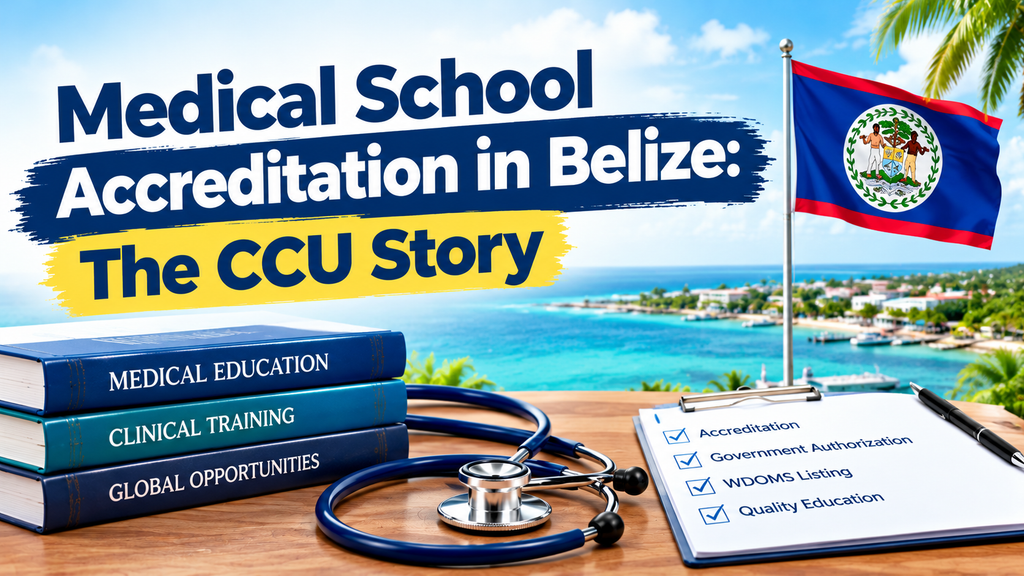
CCU is accredited by the International Association for Accreditation and Recognition (IAAR). CCU is chartered, registered, and licensed by the Government of Belize through the Ministry of Education.
These different forms of institutional status serve different purposes. This is why students should understand each one rather than treating accreditation, government authorization, and directory listing as exactly the same thing.
CCU’s Accreditation and Academic Framework
CCU’s accreditation is part of the university’s broader academic framework.
CCU’s medical program follows a U.S.-modeled curriculum and covers medical sciences, clinical skills, research and patient care. The Doctor of Medicine program is structured 5 semesters of Pre-Clinical Sciences and 6.5 semesters of Clinical Sciences and is taught in English.
The curriculum combines classroom instruction, laboratory learning, research, clinical exposure, and community involvement during the earlier stages of the program. Students then progress toward clinical learning with core and elective rotations as they advance through the program.
This structure is relevant when evaluating an accredited medical school because accreditation is not only about the name of an institution. Students should also consider how the academic program is actually organized and delivered.
Why Accreditation Matters to Medical Students
For a prospective medical student, accreditation can be an important part of evaluating a school.
It can help students understand whether an institution has undergone an external academic evaluation and whether it operates within an established educational framework.
However, accreditation should not be viewed as a guarantee of a particular career outcome. A student’s future eligibility for examinations, residency programs, or medical licensure can depend on additional requirements established by the relevant country, medical council, licensing authority, or certification organization.
This distinction is especially important for international medical students.
Accreditation, Recognition, and WDOMS Listing Are Different
Students researching medical schools may come across several terms that can appear similar but have different meanings.
Accreditation
Accreditation refers to an external evaluation against established standards by an accrediting organization.
Government Authorization
Government authorization, chartering, registration, or licensing relates to the legal or regulatory status of an educational institution within its jurisdiction.
World Directory of Medical Schools Listing
WDOMS provides information about medical schools and their programs. A listing can be useful when students are researching a medical school’s institutional information and eligibility considerations. CCU’s current WDOMS listing identifies it as a private, currently operational medical school in Belize, with instruction beginning in 2006.
These should not automatically be treated as interchangeable terms. Students should examine each status independently.
How CCU’s Medical Program Connects with Accreditation
The value of accreditation becomes clearer when it is considered alongside the actual educational program.
CCU offers a 5-semester Pre-Clinical Science curriculum with a 6.5-semester Clinical Science curriculum within the Doctor of Medicine program with a U.S.-modeled curriculum. The program includes medical sciences, clinical skills, research, patient care, laboratory work, classroom instruction, clinical exposure, and later clinical rotations.
Its clinical sciences information describes 76 weeks of clinical rotations, including core and elective experiences across different areas of medicine. The core clinical disciplines include Internal Medicine, Surgery, Obstetrics and Gynecology, Pediatrics, Psychiatry, and Family Medicine.
For students comparing medical schools, this combination of academic structure and clinical education can provide useful context when reviewing the institution’s accreditation status.
What International Students Should Verify
Accreditation is important, but it should not be the only question an applicant asks.
Before applying to a medical school in Belize, students should verify:
- The current accreditation status
- The organization responsible for accreditation
- Government authorization or licensing
- World Directory of Medical Schools listing
- Medical program structure and duration
- Clinical training arrangements
- Admission requirements
- Examination and certification requirements for the country where they plan to practice
- Current regulations of the relevant medical licensing authority
Students should also verify information directly with the medical school and the relevant regulatory organizations because accreditation and licensing requirements can change.
CCU’s Place in the Future of Medical Education in Belize
The development of medical education in Belize reflects the growing importance of international medical education and cross-border academic pathways.
For CCU, accreditation and institutional recognition form part of its ongoing medical education framework. The university combines its Belize-based medical education with a U.S.-modeled curriculum and clinical education designed to give students exposure to different areas of patient care.
For students, the more important question is not simply whether a school uses the word “accredited.” It is understanding who accredited the institution, what the accreditation covers, what other forms of recognition apply, and how those factors relate to the student’s own career plans.
What Students Should Remember
Medical school accreditation is an important part of researching medical education in Belize, but it should always be considered alongside curriculum, clinical education, institutional authorization, and future licensing requirements.
CCU has established its medical education presence in Belize since 2006 and currently identifies IAAR accreditation as recognized by WFME, Government of Belize authorization, and WDOMS listing among its institutional credentials.
For prospective students, understanding these credentials can provide a clearer picture of the institution and help them make a more informed decision about studying medicine in Belize.
Final Thoughts
Understanding medical school accreditation in Belize requires more than looking for a simple “accredited” label. Students should examine the accrediting organization, government status, medical school listing, academic program, clinical education, and the requirements that may apply after graduation.
CCU’s accreditation and institutional status are part of its development as a medical school in Belize. For international applicants, reviewing these details alongside the university’s curriculum and clinical education can provide a more complete understanding of the medical education pathway available at CCU.