
Choosing a medical school involves understanding how its academic program is organized. Before applying, students should know what they will study, how classroom learning progresses into clinical education, and which admission route matches their academic background.
For students exploring an MD program in the Caribbean, understanding these stages can make it easier to compare universities and plan their medical education. A program’s duration is one important factor, but its curriculum, entry requirements, and clinical training structure also deserve attention.
What Does a 54-Month MD Program Mean?
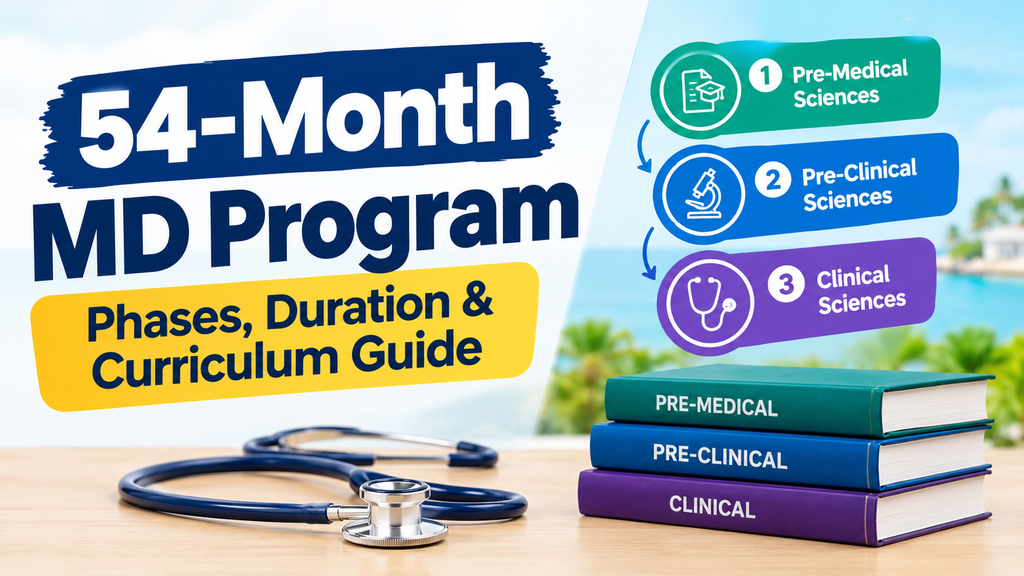
A 54-month Doctor of Medicine (MD) program spans four years and six months. During this period, students progress through different areas of medical education, moving from foundational knowledge toward clinical learning and supervised experience.
The exact structure depends on the university. Students should check how the program is divided, which subjects are included, and when clinical training begins.
At Columbus Central University (CCU), the MD program is listed as a 54-month program. Its curriculum follows a US-modeled approach and includes medical science education and clinical learning.
Students considering an MD program Caribbean universities offer should review each institution’s official curriculum rather than assuming that every program follows the same schedule.
Pre-Medical Sciences: Building Academic Readiness
Pre-Medical Sciences can provide a pathway for students who need to complete the required academic preparation before progressing into medical education.
This stage is different from studying the clinical aspects of medicine. Its purpose is to help eligible students develop the foundational knowledge and academic skills needed for further medical study.
Depending on the university’s curriculum and admission pathway, students may study foundational science subjects and strengthen their understanding of concepts used in later medical courses.
Before choosing this route, applicants should confirm:
- Whether their previous education meets the university’s entry requirements.
- Whether a premedical pathway is necessary for their academic background.
- Which subjects and credits are required.
- How progression into the MD program is determined.
CCU provides information about its Pre-Medical Sciences program. Applicants should review the current requirements to understand whether this pathway fits their qualifications.
Pre-Clinical Sciences: Understanding the Science of Medicine
Pre-Clinical Sciences focuses on the scientific knowledge that supports medical practice. Students learn about the human body, its functions, and the processes involved in health and disease.
This stage helps establish the knowledge students will need when they begin studying clinical cases and working in healthcare settings.
Subjects in medical science education can include areas such as anatomy, physiology, biochemistry, pathology, pharmacology, and microbiology. The precise subjects and their organization depend on the institution’s current curriculum.
Pre-clinical learning requires students to understand concepts rather than simply memorize information. For example, knowledge of how organs function helps students understand how diseases can affect the body.
This academic foundation also supports the transition to clinical subjects, where students begin applying scientific concepts to medical situations.
Students can explore CCU’s Pre-Clinical Sciences information to learn more about this stage of its medical education pathway.
Clinical Sciences: Connecting Knowledge With Patient Care
Clinical Sciences brings medical learning closer to the situations healthcare professionals encounter in practice. Students develop their understanding of diseases, patient assessment, diagnosis, treatment, and clinical decision-making.
Clinical education may involve hospital-based learning, supervised patient interactions, case discussions, and rotations across medical specialties. The activities students can perform depend on their training level, supervising clinicians, and the rules of the healthcare facility.
Clinical rotations are important because they allow students to observe how medical knowledge is used in real healthcare environments.
CCU’s clinical training information covers core areas such as:
- Internal Medicine
- Surgery
- Obstetrics and Gynecology
- Pediatrics
- Psychiatry
- Family Medicine
Elective rotations can also give students opportunities to explore additional areas of medicine, depending on the program’s arrangements and requirements.
Students should review the university’s current Clinical Sciences program to understand its clinical education structure and rotation requirements.
How Do the Three Phases Fit Together?
The stages of medical education serve different purposes. They help students move from academic preparation to medical science and then toward clinical application.
Pre-Medical Sciences may prepare eligible students for entry into medical education. Pre-Clinical Sciences develops the scientific foundation needed to understand health and disease. Clinical Sciences focuses on applying medical knowledge through clinical learning and supervised training.
However, these stages should not automatically be treated as three equal parts of every 54-month program. A premedical pathway may be a separate entry route, depending on a student’s qualifications and the university’s admission rules.
Applicants should therefore confirm which stages apply to their individual pathway and how the institution defines its program duration.
What Should Students Check Before Choosing an MD Program in the Caribbean?
Program length is only one part of the decision. International applicants should consider several factors before selecting a medical school.
Admission pathway: Check academic prerequisites, required documents, and whether you qualify for direct entry or need additional preparation.
Curriculum structure: Review the subjects taught, the sequence of courses, and the transition from medical sciences to clinical education.
Clinical training: Ask about rotation requirements, available specialties, training locations, and the expectations placed on students.
Accreditation and recognition: Review the school’s current official information and understand how its credentials relate to the requirements of your intended country of practice.
Total expenses: Consider tuition alongside housing, transportation, books, travel, examination fees, and other costs associated with studying abroad.
Future career plans: Research the licensing and postgraduate training requirements that apply in the country where you hope to practice medicine.
These checks help students make comparisons based on their own needs rather than program duration alone.
Conclusion
A 54-month MD program provides a defined period for medical education, but understanding its structure is just as important as knowing how long it lasts. Premedical preparation, pre-clinical study, and clinical education serve different purposes, and the route a student follows depends on the university’s program and admission requirements.
For anyone considering an MD program Caribbean universities offer, the next step is to review the curriculum, entry pathway, clinical training, and official recognition information carefully.
CCU provides detailed information about its MD program and the different stages of medical education. Prospective students should consult the university’s current program pages and admissions guidance to determine which pathway best matches their previous education and future goals.