
Choosing a medical school is an important decision for students who want to build a career in medicine. Apart from the quality of education, students also consider clinical training, tuition fees, learning environment, career goals, and opportunities for international exposure.
For students from Africa, Asia, the USA, Canada, and other regions, studying at a Medical School in Caribbean can be an option worth exploring. Caribbean medical schools can provide an international learning environment, MD programs, clinical exposure, and preparation for medical licensing pathways. However, students should always research a university’s accreditation, curriculum, clinical training, and eligibility requirements before applying.
Why Do Students Choose the Caribbean for Medical Education?
The Caribbean is not only known for its beautiful surroundings. It is also home to medical schools that attract students from different parts of the world. For many students, the combination of medical education and international exposure makes the region an interesting choice.
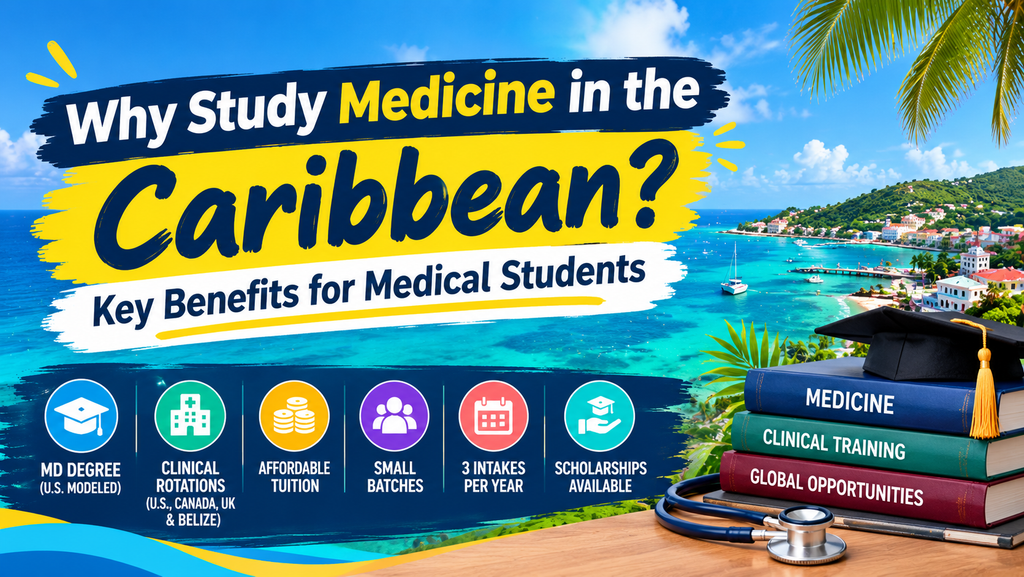
Some of the common reasons students consider Caribbean medical schools include:
- International and multicultural learning environment
- MD degree programs
- Clinical training opportunities
- Preparation for medical licensing examinations
- Multiple admission intakes at some universities
- Scholarship and financial support options
- Exposure to different healthcare systems
The right choice, however, depends on each student’s academic background and long-term career plans.
International Medical Education
One of the main benefits of studying medicine in the Caribbean is the opportunity to experience an international style of medical education. Students study important medical subjects such as anatomy, physiology, biochemistry, pathology, pharmacology, and clinical medicine.
An Accredited Medical School can also give students a structured academic pathway while helping them understand the standards and requirements connected with medical practice.
At the same time, students should not select a university based only on its location. Before applying, it is important to check the school’s current accreditation, recognition, curriculum, clinical affiliations, and licensing eligibility for the country where the student hopes to practise.
Opportunity to Earn an MD Degree
For aspiring doctors, earning an MD degree is an important part of their educational journey. Caribbean medical programs generally combine classroom learning, laboratory education, clinical sciences, and practical training.
A medical program may take students through different stages, including:
- Basic medical sciences – Building a strong foundation in subjects such as anatomy and physiology.
- Clinical sciences – Understanding how medical knowledge is applied to patient care.
- Clinical rotations – Developing practical skills through patient exposure.
- Licensing examination preparation – Preparing according to the requirements of the student’s intended career pathway.
CCU offers an MD program with a US-modeled curriculum and a structured approach to medical education.
Clinical Training and Real-World Experience
Medical education becomes more meaningful when students can apply what they learn in real healthcare settings. Clinical rotations allow students to observe and participate in patient care under appropriate supervision.
During clinical training, students can develop skills such as:
- Taking patient histories
- Performing physical examinations
- Understanding diagnostic procedures
- Communicating with patients
- Working with healthcare teams
- Applying classroom knowledge to real cases
CCU provides clinical rotation opportunities through affiliated facilities in different locations, including opportunities connected with the USA, Canada, the UK, and Belize. The exact availability and structure of rotations can depend on the program and current affiliations.
For students interested in an international career, exposure to different healthcare environments can be an important part of their medical education.
Preparing for the USMLE Pathway
Students who plan to pursue a medical career in the United States often consider the United States Medical Licensing Examination (USMLE) as part of their long-term planning.
A medical curriculum that supports USMLE preparation can help students build knowledge and clinical reasoning skills relevant to the examination pathway. CCU follows a US-modeled curriculum and incorporates USMLE-oriented preparation into its medical education approach.
The broader journey can involve several stages:
Medical Education → USMLE → Required Certification → Residency Application → Licensing Requirements
Learn in a Diverse Student Community
Another advantage of studying medicine in the Caribbean is the opportunity to interact with students from different countries and cultures.
A diverse classroom can make the learning experience more interesting because students bring different perspectives, experiences, and ways of communicating. These experiences can also help future doctors develop skills that are useful when working with patients from different backgrounds.
Students can develop:
- Better communication
- Cultural awareness
- Teamwork
- Adaptability
- Confidence in working with diverse groups
For students planning an international medical career, these qualities can become valuable throughout their professional journey.
Smaller Classes and Student Support
Medical school can be demanding, especially when students are learning a large amount of scientific information. Having access to faculty and academic support can make the learning process more manageable.
Some medical schools focus on smaller class sizes to encourage more interaction between students and faculty. At CCU, the learning approach includes small classes and personalised academic support.
This type of environment can give students more opportunities to ask questions, participate in discussions, and seek guidance when they need it.
Flexible Intakes and Financial Options
Another practical factor students may consider is the availability of multiple intakes. Instead of waiting for one specific time of the year, students may have more flexibility when a university offers several admission cycles.
CCU lists three academic intakes:
- January
- May
- September
Cost is another major consideration when selecting a medical school. Students should look beyond tuition and also consider accommodation, travel, books, insurance, examination fees, and other living expenses.
Some universities may also offer financial assistance through scholarships, payment plans, or tuition discounts. CCU provides scholarship and payment-plan options for eligible students.
What Should You Check Before Choosing a Medical School?
While there are several reasons to consider studying medicine in the Caribbean, students should do proper research before making a decision.
Check the following points carefully:
- Accreditation and recognition
- MD program structure
- Clinical rotation opportunities
- USMLE eligibility and preparation
- Tuition and total education costs
- Admission requirements
- Student support services
- Residency and licensing requirements
- Career goals and intended country of practice
This research can help students choose a program that matches their individual needs rather than simply choosing a school because it is located in the Caribbean.
Conclusion
Studying medicine in the Caribbean can provide students with an international medical education, clinical exposure, a diverse learning environment, and opportunities to prepare for future licensing pathways. For students from Africa, Asia, the USA, Canada, and other regions, it can be an option worth exploring when planning a medical career.
Universities such as CCU offer an MD pathway, clinical training opportunities, a multicultural learning environment, multiple intakes, and financial support options. However, every student’s situation is different, so accreditation, clinical training, costs, licensing requirements, and future career plans should be carefully reviewed before applying.
The best medical school is ultimately the one that fits your academic goals, career plans, budget, and intended country of practice.
Frequently Asked Questions
- Is studying medicine in the Caribbean a good option?
It can be a suitable option for students looking for international medical education, clinical exposure, and a multicultural learning environment. Students should research individual universities carefully before applying.
- Can Caribbean medical students take the USMLE?
USMLE eligibility depends on the medical school’s status and the applicable requirements. Students should verify the current requirements before starting their medical program.
- Can Caribbean medical graduates apply for U.S. residency?
Students who meet the relevant eligibility and certification requirements may apply for U.S. residency programs. However, residency placement is competitive and is not automatically guaranteed.
- What should I check before choosing a Caribbean medical school?
Students should check accreditation, recognition, curriculum, clinical rotations, USMLE eligibility, tuition, admission requirements, student support, and licensing requirements in their intended country of practice.