
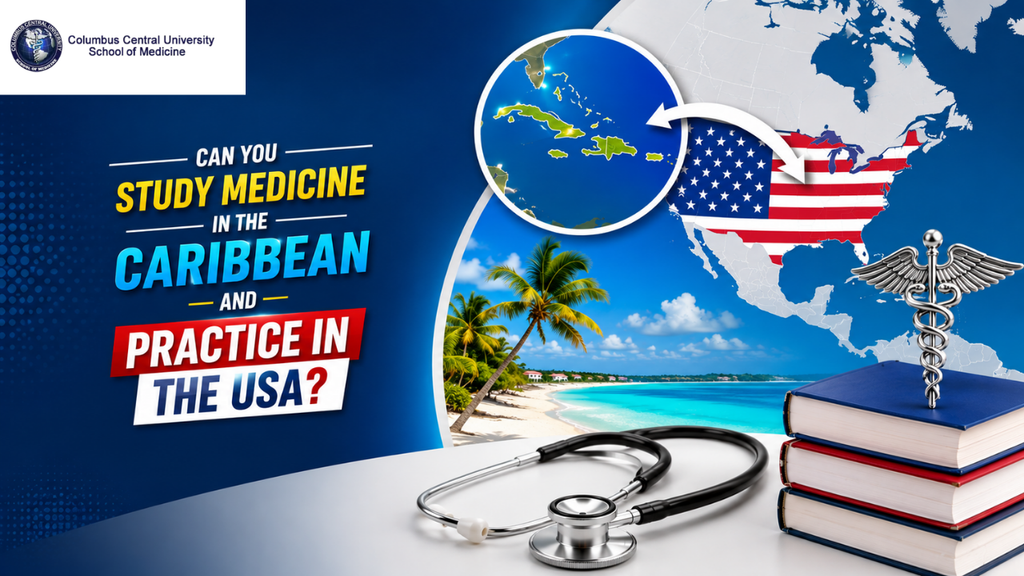
For students planning a medical career, studying in another country can raise many questions. One of the most common is whether studying at a medical school in the Caribbean can lead to a medical career in the USA.
The answer depends on several factors. Studying medicine in the Caribbean does not by itself give a student the right to practise medicine in the USA. Students must complete their medical education and then meet the examination, certification, residency, and licensing requirements that apply to international medical graduates.
For this reason, students should understand the complete pathway before choosing a medical school.
How Does the Pathway Work?
The journey from medical school to practising medicine in the USA involves several stages. A student first completes medical education and develops the academic and clinical knowledge needed for medical practice.
After medical school, students who plan to continue toward the U.S. pathway need to meet the relevant requirements for international medical graduates. This can include examinations, certification, residency applications, and state-specific licensing requirements.
The exact process can vary depending on the student’s circumstances and the rules in place when they graduate.
Why Do Students Consider a Medical School in the Caribbean?
Students from different parts of the world consider Caribbean medical education for a variety of reasons. Some may be looking for an international learning environment, while others may have long-term plans to pursue medical opportunities in the USA, Canada, or another country.
The important point is that students should look at their complete career plan before making a decision. The location of a medical school is only one factor. Academic preparation, clinical education, eligibility, and future requirements are also important.
What Role Does Clinical Training Play?
Medical education is not limited to classroom learning. Clinical training gives students the opportunity to connect their academic knowledge with practical healthcare experiences.
Rotational training can expose students to different healthcare environments and help them understand how medical care is delivered in real clinical settings. For students interested in an international medical career, understanding the clinical component of their program is an important part of choosing a medical school.
CCU provides opportunities for rotational training in hospitals in the USA, Canada, the UK, and Belize, according to the program information provided by CCU. Students should check the current details of available rotations, including eligibility and placement arrangements, before making plans based on a particular location.
Can Studying at CCU Lead to a U.S. Medical Career?
CCU offers an MD medical education pathway for students considering an international medical career. Students who have the USA as a future goal need to understand that graduating from medical school is not the final step.
The U.S. pathway has additional requirements for international medical graduates. Students must understand the examinations, certification process, residency requirements, and licensing rules that apply to them.
Therefore, it is better to think of medical school as the foundation of the journey, rather than as a guarantee of a particular career outcome.
What About the Medical Degree?
Students often want to know whether studying medicine in the Caribbean can be part of a pathway toward practising in the USA.
The important distinction is between earning a medical degree and being licensed to practise medicine. A medical degree is an important part of becoming a physician, but graduates must still satisfy the requirements of the country where they want to practise.
For someone planning to work in the USA, this means researching the U.S. requirements alongside their medical education rather than waiting until graduation.
What Should Students Check Before Applying?
Before choosing a Caribbean medical school, students should take time to understand the full program and their future plans.
Some useful questions include:
- What are the admission requirements?
- What medical program does the school offer?
- What clinical training opportunities are available?
- Where can clinical rotations take place?
- What examinations will be required for the intended career pathway?
- What certification requirements apply to international medical graduates?
- What are the requirements for residency?
- What licensing rules apply in the state where the student hopes to practise?
Finding answers to these questions can help students make a decision based on their own career goals.
A Caribbean Medical School Is Only the Beginning
Choosing to study medicine in the Caribbean can be the beginning of an international medical journey. However, students should have realistic expectations about what happens after medical school.
A student who wants to practise in the USA needs to plan beyond graduation. Medical education, clinical experience, examinations, certification, residency, and licensing all form part of the wider journey.
This is why researching the pathway early can be useful. It allows students to understand what they are working toward and what requirements they may need to meet along the way.
Final Thoughts
Yes, studying medicine in the Caribbean can be part of a pathway toward practising medicine in the USA. However, there is no automatic transition from a Caribbean medical school to U.S. medical practice.
Students need to complete their medical education and meet the requirements that apply to international medical graduates. They should also keep themselves informed about current examination, certification, residency, and licensing rules.
For students considering CCU, understanding the medical program and its clinical training opportunities can help them decide whether the pathway fits their long-term goals. The best decision is one based on accurate information, realistic expectations, and a clear understanding of what comes after medical school.